
E-Marker IC Chips Explained: Why Your 100W/240W USB-C Cable Needs One
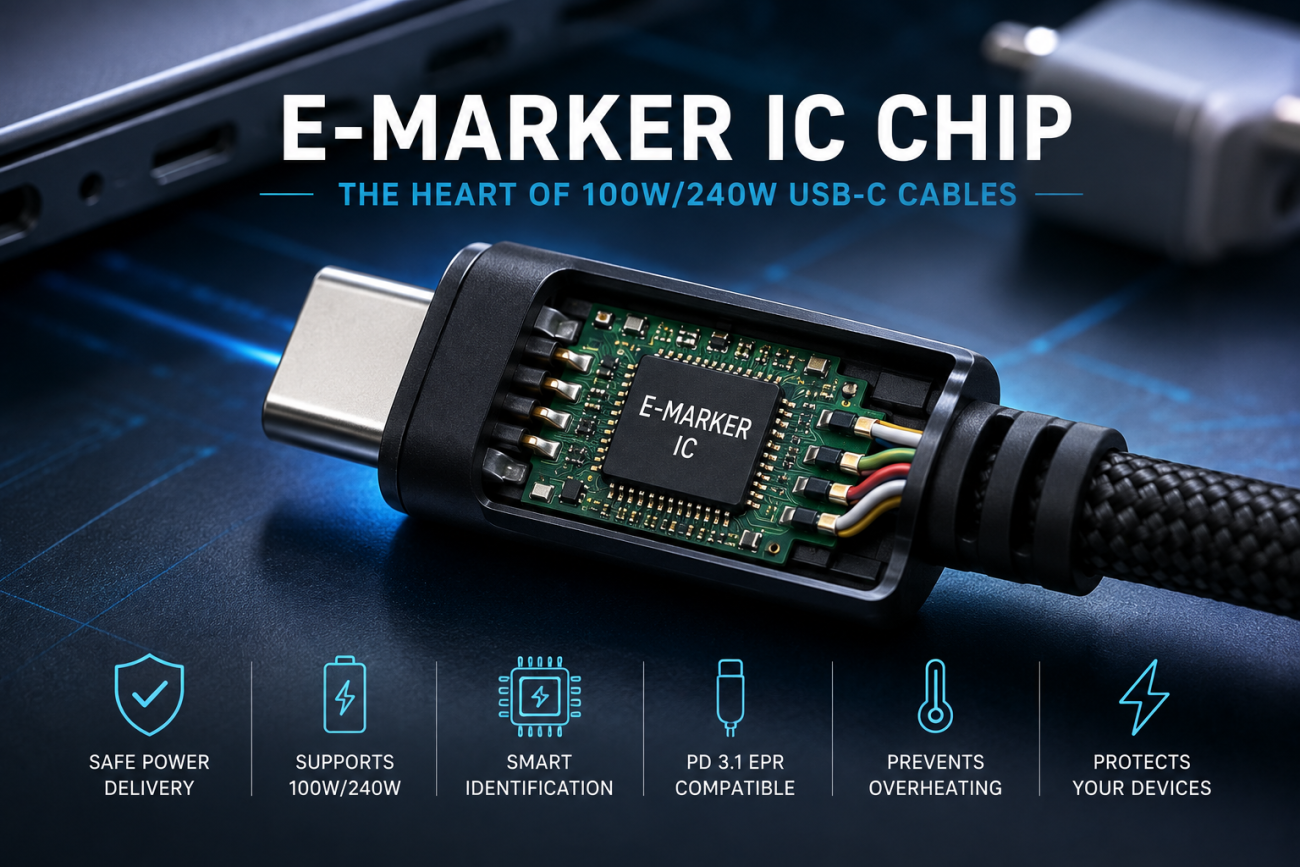
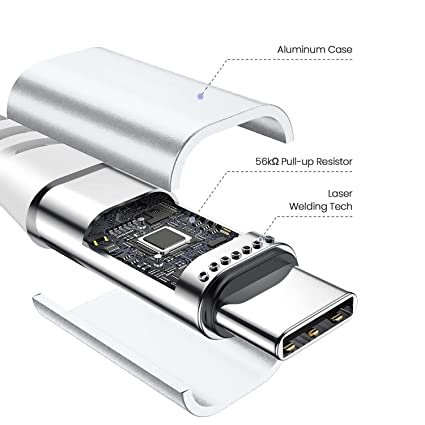
An E-Marker IC chip is a small integrated circuit built into high-power USB-C cables that identifies the cable’s capabilities to connected devices. It is required for most 100W (5A) and 240W (48V/5A) USB-C cables to enable safe power negotiation under the USB Power Delivery (USB PD) specification.
Why Does a 100W or 240W USB-C Cable Need an E-Marker IC Chip?
What Is an E-Marker IC Chip?
An Electronically Marked Cable Assembly (E-Marker) is a programmable integrated circuit embedded inside a USB-C connector. Its job is to communicate the cable’s electrical characteristics to the charger and the connected device through the Configuration Channel (CC) pins.
Unlike a standard charging cable, an E-Marker cable actively tells the connected devices:
Maximum current rating
Supported voltage
USB protocol compatibility
Data transfer capability
Cable identity
Vendor information (optional)
Product ID and firmware information
Without this communication, many USB-C devices will automatically reduce charging power to protect both the cable and the connected equipment.
How Does an E-Marker IC Work?
How Does the Chip Communicate With Devices?
When a USB-C cable is plugged into a charger and a device, the communication process begins before high-power charging starts.
The typical sequence is:
- The charger detects a USB-C connection.
- Communication begins over the CC (Configuration Channel) pins.
- The charger reads the E-Marker IC information.
- The charger verifies the cable’s current and voltage capability.
- Safe power negotiation begins using the USB Power Delivery protocol.
Only after successful verification will the charger deliver higher power levels.
For example:
A 100W USB-C charger checks whether the cable is rated for 5A.
If the cable is only rated for 3A, the charger limits output to protect the cable.
This automatic negotiation greatly reduces the risk of overheating and electrical damage.
When Is an E-Marker Chip Required?
Do All USB-C Cables Need an E-Marker?
No.
Not every USB-C cable requires an E-Marker IC.
The USB-IF specification generally requires an E-Marker for cables designed to carry more than 3A, including:
| Cable Type | Maximum Current | Maximum Power | E-Marker Required |
|---|---|---|---|
| Standard USB-C Cable | 3A | Up to 60W | No |
| USB-C 5A Cable | 5A | Up to 100W | Yes |
| USB PD 3.1 EPR Cable | 5A | Up to 240W | Yes |
| USB4 Passive Cable (depending on specification) | 5A | Up to 240W | Typically Yes |
For most 100W and 240W USB-C charging cables, an E-Marker IC is a mandatory part of the design.
Why Can’t a 100W USB-C Cable Work Reliably Without an E-Marker?
What Happens Without the Chip?
Without an E-Marker IC, the charger cannot verify that the cable is capable of safely carrying higher current.
The result may include:
Charging limited to lower power
Charging interruptions
Slower charging speed
Cable overheating
Higher voltage drop
Reduced safety margin
Modern USB-C chargers prioritize safety. If cable capability cannot be confirmed, they intentionally reduce output power.
What Information Is Stored Inside an E-Marker IC?
What Data Does the Chip Report?
An E-Marker IC contains non-volatile memory programmed during manufacturing.
Typical information includes:
Maximum current rating (3A or 5A)
Supported voltage
USB Power Delivery compatibility
USB4 compatibility (if applicable)
Thunderbolt compatibility (if applicable)
Cable speed capability
Vendor ID (VID)
Product ID (PID)
Firmware version
This information helps connected devices make intelligent decisions before delivering power or transferring data.
How Does an E-Marker Support USB Power Delivery?
What Is the Relationship Between E-Marker and USB PD 3.0?
The E-Marker IC works together with the USB Power Delivery (USB PD) protocol.
USB PD allows the charger and device to negotiate different voltage and current levels.
Typical USB PD power profiles include:
| USB PD Standard | Maximum Voltage | Maximum Current | Maximum Power |
|---|---|---|---|
| USB PD 2.0 | 20V | 5A | 100W |
| USB PD 3.0 | 20V | 5A | 100W |
| USB PD 3.1 EPR | 48V | 5A | 240W |
Without a correctly programmed E-Marker IC, the charger may refuse to provide the full 5A current required for 100W or 240W charging.
Does an E-Marker Improve Charging Speed?
Is the Chip Responsible for Fast Charging?
Not directly.
The E-Marker does not generate more power or charge a device faster by itself.
Instead, it enables higher charging levels by confirming that the cable is designed to handle them safely.
Actual charging speed depends on:
Charger output
Device charging capability
USB PD support
Cable quality
Internal conductor size
Temperature management
The E-Marker is one part of the complete charging system.
Why Does Cable Construction Matter?
Can Any USB-C Cable Carry 100W or 240W?
No.
An E-Marker alone cannot compensate for poor cable construction.
A reliable high-power USB-C cable also requires:
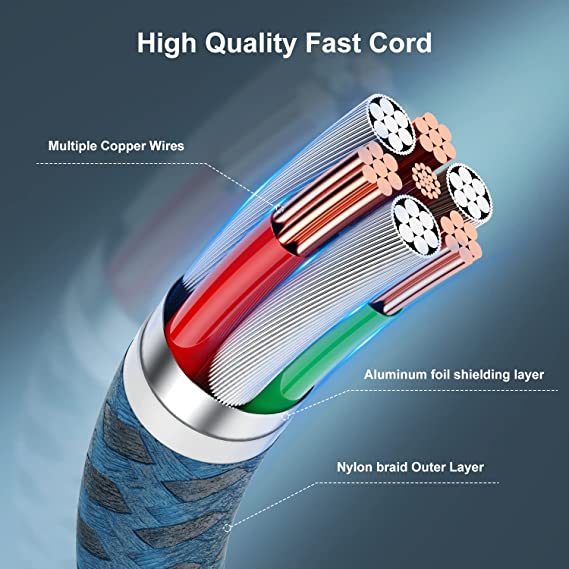
Pure copper conductors
Appropriate AWG wire gauge
Multi-layer shielding
High-quality insulation
Precision connector assembly
Typical conductor recommendations include:
| Cable Rating | Typical Power Wire Size |
|---|---|
| 60W Cable | 24AWG–26AWG |
| 100W Cable | 22AWG–24AWG |
| 240W Cable | 20AWG–22AWG |
Thicker conductors reduce resistance, improve efficiency, and minimize heat generation during high-current charging.
How Are E-Marker USB-C Cables Manufactured?
What Manufacturing Standards Should Buyers Expect?
Professional manufacturers use controlled production processes to ensure every E-Marker cable performs consistently.
Typical manufacturing controls include:
ISO9001 Quality Management System
An ISO9001-certified factory documents and controls:
Incoming material inspection
Supplier qualification
Production processes
Product traceability
Corrective actions
Final inspection
Quality departments generally include:
IQC (Incoming Quality Control)
IPQC (In-Process Quality Control)
OQC (Outgoing Quality Control)
Why Is Lead-Free Solder Important?
Most professional USB-C cable manufacturers use SAC305 lead-free solder.
Typical composition:
Tin (Sn): 96.5%
Silver (Ag): 3.0%
Copper (Cu): 0.5%
Typical processing temperatures:
Melting point: approximately 217°C
Reflow process: 240–260°C
Lead-free solder supports:
RoHS compliance
Strong mechanical joints
Stable electrical performance
Poor soldering can lead to:
Intermittent charging
Increased resistance
Connector failure
What Certifications Should an E-Marker USB-C Cable Have?
Which Compliance Documents Should B2B Buyers Request?
Before placing bulk orders, buyers should verify that the manufacturer can provide appropriate compliance documentation.
Common certifications and standards include:
| Certification / Standard | Purpose |
|---|---|
| ISO9001 | Quality management system |
| RoHS | Restricts hazardous substances |
| REACH | Chemical compliance |
| UL Recognized Components / UL Cable Certification (where applicable) | Electrical safety |
| USB-IF Compliance | USB specification verification |
For OEM and ODM projects, request:
Product specification sheet
Electrical test reports
Material declarations
USB PD compatibility reports
E-Marker programming verification
Quality Inspector’s Advice:
“Do not assume every cable labeled ‘100W’ or ‘240W’ is built correctly. Verify the E-Marker programming, conductor size, electrical test reports, and production records. A genuine high-power cable combines the right chip with the right materials and quality control.”
How Should Businesses Choose an E-Marker USB-C Cable Manufacturer?
What Questions Should Buyers Ask Before Ordering?
Before selecting a supplier, ask these questions:
Engineering Capability
Do you manufacture 100W and 240W USB-C cables?
Which E-Marker IC suppliers do you use?
Can you program custom E-Marker firmware?
Product Quality
What AWG conductors are used?
Are the conductors pure copper?
What shielding structure is used?
Quality Control
Is every cable electrically tested?
Do you verify E-Marker programming?
Can you provide USB PD compatibility reports?
Manufacturing
Is the factory ISO9001 certified?
Are RoHS and REACH documents available?
What is the monthly production capacity?
Selecting an experienced manufacturer helps reduce warranty claims, improve charging reliability, and maintain product consistency across large production volumes.
Conclusion
The E-Marker IC is a critical component in modern 100W and 240W USB-C cables. It allows chargers and devices to verify cable capability before high-power charging begins, making USB Power Delivery safer and more reliable.
For B2B buyers, evaluating an E-Marker cable means looking beyond the connector. Conductor size, USB PD compatibility, E-Marker programming, manufacturing quality, and compliance documentation all contribute to long-term product performance.
Choosing a manufacturer with proven engineering expertise, ISO9001 quality management, and comprehensive testing is the most effective way to ensure reliable high-power USB-C cables.
FAQ
1. Is an E-Marker chip required for every USB-C cable?
No. Standard USB-C cables rated up to 3A (typically up to 60W) generally do not require an E-Marker. Cables designed for 5A operation, including most 100W and 240W USB-C cables, do.
2. Can a USB-C cable charge at 100W without an E-Marker?
In most cases, no. USB Power Delivery systems typically require an E-Marker to verify that a cable is rated for 5A before allowing 100W charging.
3. Does an E-Marker increase charging speed?
The chip does not create additional power. It enables the charger and device to safely negotiate higher power levels when the cable is designed to support them.
4. How can I verify that a USB-C cable has a genuine E-Marker?
Request the manufacturer’s specifications, USB-IF or compatibility test reports, electrical test records, and confirmation that the E-Marker has been correctly programmed during production.
USB cable.
Picture this: You’re sitting at your desk, engrossed in a project
Where Can I Buy a High-Quality Pd Fast Charging Cable?
FAQ
1 cable
USB-C cables certainly.
Share This Artcle:

Fast delivery
Fastest delivery within 22 days

Quick proofing
Fastest 3-day proofing cycle

After-sale protection
24-month long warranty

1V1Customer Service
Professional customer service follow-up
Lorem ipsum dolor sit amet, consectetur adipiscing elit. Ut elit tellus, luctus nec ullamcorper mattis, pulvinar dapibus leo.