
60W vs. 100W vs. 240W USB-C Cables: What Is the Difference?
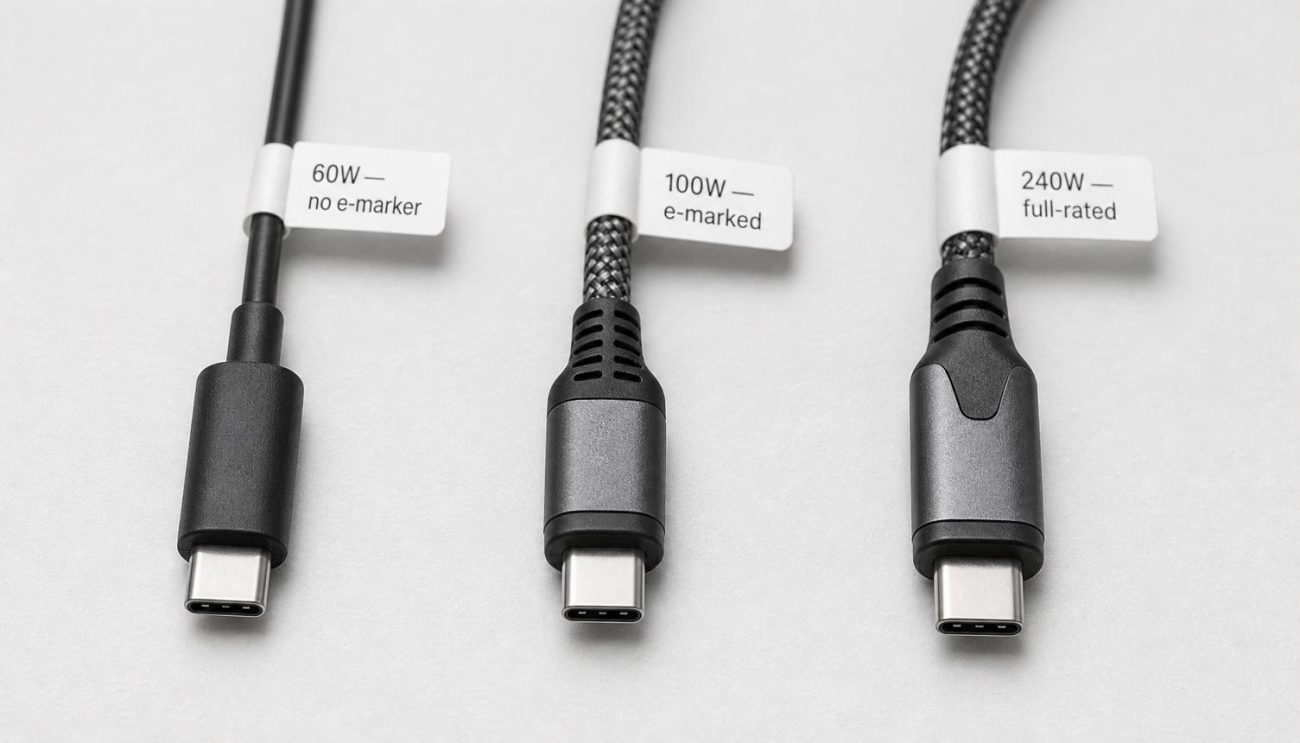
The main difference between 60W, 100W, and 240W USB-C cables is their maximum supported power. A 60W cable typically supports 20V/3A, a traditional 100W cable supports 20V/5A, and a 240W cable supports up to 48V/5A using USB Power Delivery Extended Power Range (EPR). The correct choice depends on the device, charger, and cable specifications.
1. What Do 60W, 100W, and 240W Mean for USB-C Cables?
The wattage rating tells buyers how much electrical power a cable is designed to carry under specified conditions.
Power is calculated using a simple formula:
Power (W) = Voltage (V) × Current (A)
For example:
20V × 3A = 60W
20V × 5A = 100W
48V × 5A = 240W
A higher wattage rating allows a cable to support higher-power charging when the charger and device also support the required USB Power Delivery (USB PD) mode.
USB-C Cable Power Comparison
| Feature | 60W USB-C Cable | 100W USB-C Cable | 240W USB-C Cable |
|---|---|---|---|
| Typical voltage/current | 20V / 3A | 20V / 5A | 48V / 5A |
| Maximum rated power | 60W | 100W | 240W |
| USB PD range | SPR | SPR | EPR |
| E-Marker | Not required for standard 3A operation | Required for 5A operation | Required, with EPR capability |
| Typical applications | Phones, tablets, many laptops | Higher-power laptops and accessories | High-power laptops, workstations, and compatible devices |
| Power capability | Standard | Higher | Extended high power |
Important purchasing note: The 100W rating is still commonly used in commercial product descriptions and refers to the traditional 20V/5A cable capability. However, USB-IF updated its USB-C-to-USB-C cable compliance and marking program: compliant cable categories use 60W or 240W power markings, and USB-IF discontinued certification of the old 100W cable category. Buyers should distinguish a legacy or commercial 100W claim from current USB-IF compliance status.
2. What Is a 60W USB-C Cable?
A 60W USB-C cable typically supports up to 20V at 3A under USB Power Delivery.
It is a practical choice for everyday charging applications where 60W is sufficient.
Main Features of 60W Cables
Supports up to 3A current.
Typically supports USB PD charging up to 60W.
Does not require an E-Marker for standard 3A operation.
Can be designed for USB 2.0 or higher data-transfer capabilities, depending on the product specification.
Often suitable for smartphones, tablets, and compatible laptops.
Which Devices Can Use a 60W Cable?
Common applications include:
Smartphones with USB-C charging.
Tablets and portable devices.
Ultrabooks and laptops that accept charging at 60W or less.
USB-C power banks.
Everyday office and travel charging accessories.
Actual charging power depends on the device’s maximum input power, charger output, charging protocol, and cable capabilities.
Is a 60W Cable Enough for Most Buyers?
For general smartphone and tablet charging, a 60W cable may provide more than enough power.
For laptop charging, buyers should check the device’s recommended power adapter. A laptop designed for a 100W charger may charge more slowly or may not maintain full performance with a 60W cable.
B2B purchasing tip: A 60W cable can be a good entry-level product for wholesalers and retailers targeting everyday mobile accessories. It can also be offered in multiple lengths and jacket materials, such as PVC, TPE, and nylon-braided constructions.
3. What Is a 100W USB-C Cable?
A traditional 100W USB-C cable supports up to 20V at 5A under USB Power Delivery.
Compared with a standard 60W cable, it supports a higher current and is designed for devices requiring more charging power.
Main Features of 100W Cables
- Supports up to 5A current.
- Traditional maximum power is 100W.
- Requires an E-Marker chip for 5A operation.
- Commonly used for compatible laptops and high-power USB-C accessories.
- May support USB 2.0 or faster data transfer, depending on its construction and specification.
Why Does a 100W Cable Need an E-Marker?
An E-Marker (Electronically Marked Cable) is a small identification chip built into a compatible USB-C cable assembly.
It communicates cable capabilities to connected equipment, including supported current and other relevant cable information.
For a cable carrying more than 3A, the E-Marker is required to identify its 5A capability.
Without the appropriate cable identification, a USB PD system will not authorize operation above the standard 3A cable limit.
Which Devices Can Use a 100W Cable?
Typical applications include:
- Compatible business laptops.
- USB-C docking stations and accessories.
- Tablets with higher-power charging requirements.
- Portable monitors and other USB-C equipment.
- High-performance mobile workstations that support 100W input.
Is 100W Still a Good Product Specification?
A traditional 100W cable can still appear in existing products, commercial catalogs, and customer specifications.
However, buyers developing new USB-IF-compliant USB-C-to-USB-C cable products should understand the updated 60W/240W marking and certification approach. Do not assume that a cable advertised as 100W automatically qualifies for current USB-IF certification.
For new product development, discuss the intended rating, applicable specification, and certification requirements with the manufacturer before placing an order.
4. What Is a 240W USB-C Cable?
A 240W USB-C cable is designed for high-power charging using USB Power Delivery 3.1 Extended Power Range (EPR).
It supports up to 48V at 5A, providing a maximum rated power of 240W.
This is significantly higher than the traditional 100W USB-C charging capability.
Main Features of 240W Cables
- Supports up to 48V and 5A.
- Maximum rated power of 240W.
- Requires an E-Marker with EPR capability.
- Designed for USB PD 3.1 EPR applications.
- Requires suitable electrical insulation and component ratings for the higher operating voltage.
- Must meet the applicable EPR cable requirements.
What Is EPR?
EPR stands for Extended Power Range.
It was introduced with USB Power Delivery 3.1 to extend USB-C power delivery beyond the previous 100W limit.
The EPR fixed voltage levels include:
| EPR Voltage | Maximum Current | Maximum Power |
|---|---|---|
| 28V | 5A | 140W |
| 36V | 5A | 180W |
| 48V | 5A | 240W |
A 240W cable is therefore not simply a traditional 100W cable with a different label. It needs an EPR-capable cable assembly, appropriate E-Marker identification, and components designed for the higher voltage.
Which Devices Need a 240W Cable?
Potential applications include:
- High-performance laptops.
- Mobile workstations.
- Compatible professional computing equipment.
- High-power USB-C devices.
- Future-ready USB-C charging accessories.
Not every laptop or charger needs a 240W cable. The device, power adapter, and cable must all support the required EPR power level.
B2B purchasing tip: A 240W cable may be suitable for premium charging accessory ranges, professional electronics markets, and private-label brands targeting high-power laptop users.
5. What Is the Difference Between E-Marker Chips in 60W, 100W, and 240W Cables?
The E-Marker is an important component in high-current USB-C cable assemblies.
It provides cable identification information so that the connected charger and device can determine which power capabilities the cable supports.
E-Marker Requirements
| Cable Rating | Maximum Current | E-Marker Requirement |
|---|---|---|
| 60W | 3A | Not required for standard 3A operation |
| Traditional 100W | 5A | Required |
| 240W | 5A | Required, with EPR capability |
The key difference is not simply whether an E-Marker exists. Buyers must verify whether the chip correctly identifies the cable’s supported current and, for EPR, its extended voltage capability.
How Can Buyers Check an E-Marker?
For bulk purchasing, ask the supplier to provide:
- The E-Marker chip specification or identification information.
- Evidence that the chip matches the cable’s advertised power rating.
- Relevant electrical and functional test results.
- Applicable USB-IF compliance or certification evidence, where claimed.
- Confirmation that the E-Marker and cable assembly remain consistent with the approved production sample.
A cable should not be marketed as 240W simply because it contains an E-Marker. The complete cable assembly must meet the applicable EPR requirements.
6. Does a 240W USB-C Cable Charge Faster Than a 60W or 100W Cable?
Not necessarily.
A 240W cable has a higher maximum power capability, but it does not force a device to charge at 240W.
The actual charging power depends on three main components:
- Charger: The power adapter must support the required USB PD voltage and current.
- Cable: The cable must support the required power level.
- Device: The connected device must accept the required charging power.
For example:
| Charger | Cable | Device | Expected Result |
|---|---|---|---|
| 60W | 60W | 60W maximum | Up to 60W |
| 100W | 60W | 100W maximum | Limited by the cable to 60W |
| 100W | 240W | 100W maximum | Up to 100W |
| 240W | 100W | 240W maximum | Limited by the cable’s supported capability |
| 240W | 240W | 240W maximum | Up to 240W, if all conditions are met |
These are simplified examples. Actual negotiated power depends on supported USB PD profiles and system conditions.
The key point: A higher-rated cable provides more power headroom, but charging speed is determined by the complete charging system.
7. Are 60W, 100W, and 240W USB-C Cables Different in Appearance?
Not always.
Many USB-C cables use the same connector shape, so it can be difficult to identify their power capabilities by looking at the plug alone.
However, the internal construction may be different.
Common Construction Differences
| Component | 60W Cable | Traditional 100W Cable | 240W Cable |
|---|---|---|---|
| Current capability | Up to 3A | Up to 5A | Up to 5A |
| E-Marker | Not required for standard 3A | Required | EPR-capable E-Marker required |
| Conductor design | Designed for specified 3A operation | Designed for specified 5A operation | Designed for specified 5A EPR operation |
| Insulation requirements | Based on rated design | Based on rated design | Must meet applicable EPR voltage requirements |
| Connector assembly | Suitable for specified rating | Suitable for specified rating | Suitable for EPR operation |
| Testing | Electrical and functional tests | Includes relevant 5A verification | Includes relevant EPR and high-voltage testing |
A 240W cable may require more demanding component selection, insulation design, and validation. However, a thicker cable is not automatically a better or compliant 240W cable.
For manufacturers, the conductor size, insulation system, connector components, E-Marker, and complete assembly must be evaluated together.
8. How Should Importers and Wholesalers Choose Between 60W, 100W, and 240W Cables?
The right product depends on the target customer, application, and market positioning.
Choose 60W for Everyday Charging Markets
A 60W product can be suitable for:
- Smartphone and tablet accessory retailers.
- General electronics wholesalers.
- Entry-level charging cable collections.
- Online accessory brands.
- Customers who do not need high-power laptop charging.
It is a practical option when cost competitiveness and broad everyday use are important.
Choose Traditional 100W for Existing Product Requirements
A traditional 100W cable may be appropriate when:
- A customer has an existing 100W product specification.
- A buyer is replenishing an established product line.
- The target device requires up to 100W.
- The cable’s E-Marker and technical requirements are verified.
For new USB-IF certification projects, confirm the current 60W/240W cable category requirements rather than assuming the traditional 100W category is still certifiable.
Choose 240W for Premium and High-Power Markets
A 240W cable may be a good fit for:
- Premium laptop accessories.
- Professional electronics distributors.
- High-performance computing accessories.
- Private-label brands targeting premium charging products.
- Buyers who want an EPR-capable cable portfolio.
For these products, supplier experience and testing capability are especially important.
9. What Quality Tests Should Buyers Request Before Bulk Purchasing?
Power rating alone does not prove that a USB-C cable is reliable.
Importers and wholesalers should check the following before approving a large order.
| Quality Test | What It Checks | Why It Matters |
|---|---|---|
| E-Marker verification | Cable identification and power capability | Confirms the cable reports the appropriate capabilities |
| Voltage and current test | Electrical operation under specified conditions | Verifies rated power performance |
| Resistance test | Conductor and connection resistance | Helps identify excessive electrical losses |
| Temperature-rise test | Temperature under defined operating conditions | Checks thermal performance |
| Connector insertion/extraction test | Mechanical fit and retention | Reduces loose-connector problems |
| Bending test | Cable flexibility and conductor durability | Helps identify premature cable failure |
| Pull test | Mechanical connection strength | Checks cable-to-connector integrity |
| Insulation and dielectric testing | Electrical insulation performance | Important for applicable high-voltage designs |
| Data-transfer test | Advertised data capability | Confirms the cable’s specified data performance |
For 240W products, buyers should pay particular attention to EPR identification, voltage-rated components, insulation performance, and applicable compliance testing.
Ask the manufacturer for documented test procedures and results for the exact model being purchased.
10. What Should B2B Buyers Ask a USB-C Cable Manufacturer?
Before placing an order, importers and wholesalers should confirm the following information:
- What is the maximum supported power rating?
- Does the cable support USB PD 3.0 or USB PD 3.1 EPR, as applicable?
- Does the product include an E-Marker?
- For a 240W cable, does the E-Marker identify EPR capability?
- What data-transfer speed does the cable support?
- What conductor and insulation specifications are used?
- Which connector and overmolding materials are available?
- What lengths and colors can be customized?
- Can the manufacturer provide electrical and durability test reports?
- Can the product be customized with a private label and retail packaging?
A reliable manufacturer should be able to explain the product specifications and provide evidence that the finished cable matches the agreed requirements.
Frequently Asked Questions
Can a 60W USB-C cable charge a laptop?
Yes, if the laptop supports USB-C charging at 60W or less. A laptop that requires more power may charge more slowly or may not operate at full performance while charging.
Can a 100W USB-C cable charge a 240W laptop?
It may charge the laptop at a lower supported power level if the charger and laptop negotiate a compatible mode. However, it cannot provide the full 240W EPR capability.
Does a 240W USB-C cable support fast data transfer?
Not automatically. Power capability and data-transfer speed are separate specifications. A 240W cable may support only USB 2.0 data transfer at up to 480Mbps, unless it is specifically designed and rated for faster data.
Do all 240W USB-C cables need an E-Marker?
Yes. A 240W USB-C cable requires an EPR-capable E-Marker to identify its extended power capability. The complete cable assembly must also meet the applicable EPR requirements.
Conclusion
The main difference between 60W, 100W, and 240W USB-C cables is their supported power capability and the technical requirements needed to deliver that power safely.
A 60W cable is suitable for many everyday charging applications. A traditional 100W cable supports higher-current charging and requires an E-Marker. A 240W cable uses USB PD 3.1 EPR technology and requires an EPR-capable E-Marker and a cable assembly designed for higher voltage.
For importers, wholesalers, and private-label brands, the best purchasing decision is not always to choose the highest wattage. It is to select a cable that matches the target device, market demand, required data performance, and quality standards.
USB cable.
Picture this: You’re sitting at your desk, engrossed in a project
Where Can I Buy a High-Quality Pd Fast Charging Cable?
FAQ
1 cable
USB-C cables certainly.
Share This Artcle:


Fast delivery
Fastest delivery within 22 days

Quick proofing
Fastest 3-day proofing cycle

After-sale protection
24-month long warranty

1V1Customer Service
Professional customer service follow-up
Lorem ipsum dolor sit amet, consectetur adipiscing elit. Ut elit tellus, luctus nec ullamcorper mattis, pulvinar dapibus leo.