
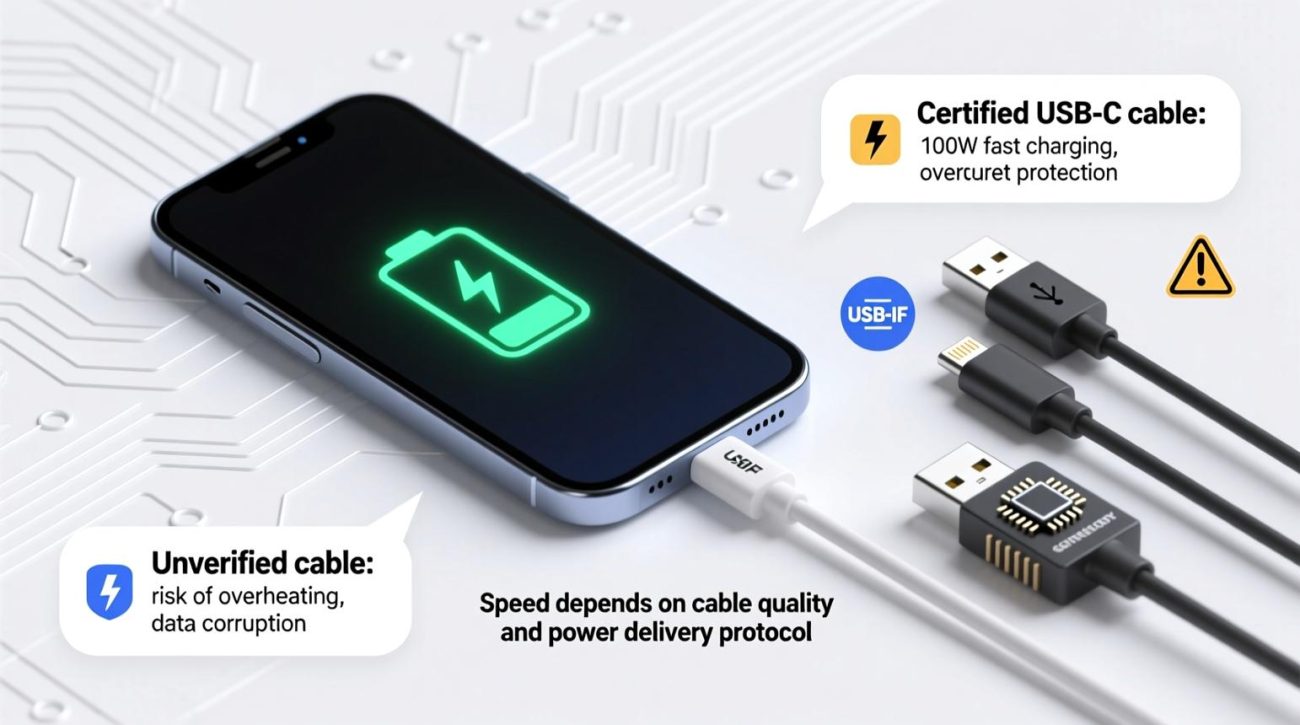
When shopping for a USB-C charging cable, you’ve probably seen product descriptions such as:
100W Fast Charging
140W USB-C Cable
240W USB-C Cable
USB Power Delivery (PD)
E-Marker Chip Built-In
Many people understand charging power, but few know what the E-Marker chip actually does.
In reality, the:
E-Marker Chip
is one of the most important components inside a modern USB-C cable.
Without it, many high-power charging cables simply cannot safely deliver 100W, 140W, or 240W charging.
You can think of the E-Marker chip as:
The Brain of the USB-C Cable
Its job is to communicate with the charger and device, telling them exactly what the cable is capable of handling.
In this article, we’ll explain everything you need to know about E-Marker chips, how they work, why they are required for fast charging, and how they help protect your devices.

What Is an E-Marker Chip?
E-Marker stands for:
Electronically Marked Integrated Circuit
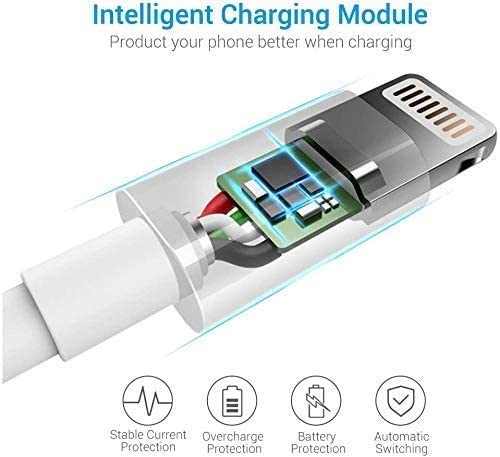
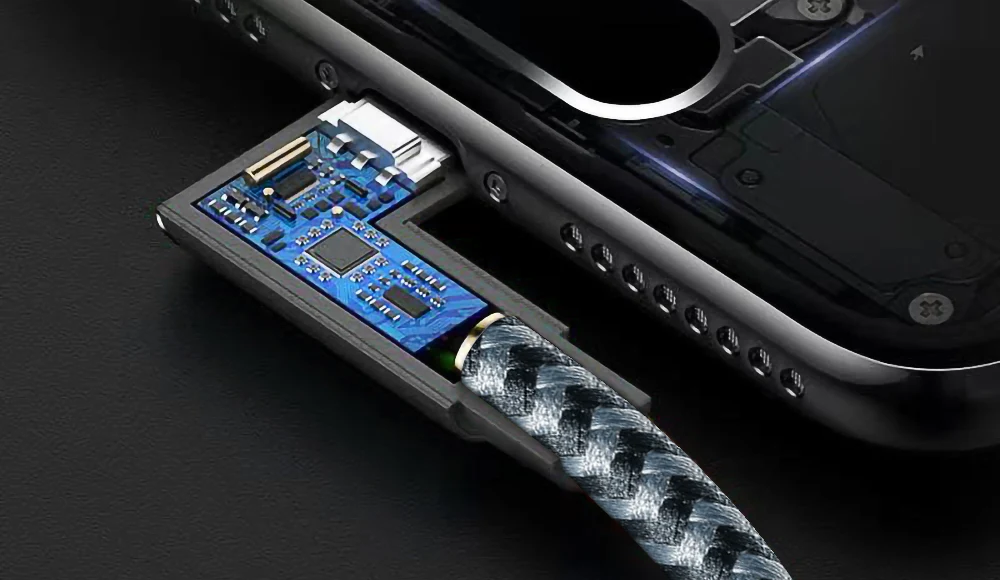
It is a tiny smart chip embedded inside the USB-C connector.
Unlike ordinary charging cables, cables equipped with an E-Marker chip can actively communicate with connected devices.
The chip stores important information about the cable, including:
Maximum current capacity
Maximum voltage rating
Data transfer capabilities
USB certification information
Manufacturer identification
Whenever you connect the cable, the E-Marker chip automatically reports this information to the charger and device.
Why Is an E-Marker Chip Necessary?
Years ago, charging cables were relatively simple.
Most cables only supported:
5V charging
Low current transmission
Basic data transfer
Modern USB-C technology is very different.
Today, a single cable may support:
100W charging
140W charging
240W charging
USB4 data transfer
Thunderbolt connectivity
These performance levels require intelligent communication.
This is where the E-Marker chip becomes essential.
The E-Marker Chip Is the Cable’s Digital Identity Card
Think of the E-Marker chip as a digital ID card.
When you connect a USB-C cable, the charger immediately asks:
“What are your capabilities?”
The E-Marker chip responds with information such as:
“I support 5A current.”
“I support 100W charging.”
“I support USB4 transmission.”
“I can safely handle high-power charging.”
Only after receiving this information will the charger allow higher power delivery.

Why Is E-Marker Required for 100W Charging?
According to USB Power Delivery specifications:
Any USB-C Cable Supporting 5A Current Must Include an E-Marker Chip
This is a mandatory requirement.
Without an E-Marker chip, most devices automatically limit charging power.
For example:
Without E-Marker:
20V × 3A = 60W Maximum

With E-Marker:
20V × 5A = 100W Maximum
The E-Marker chip tells the charger:
“This cable can safely carry 5 amps.”
Only then will higher charging power be unlocked.
Why Is E-Marker Even More Important for 240W Charging?
The latest USB Power Delivery 3.1 standard introduced:
Extended Power Range (EPR)
This enables charging up to:
240W
using:
48V × 5A = 240W
At this power level, safety becomes extremely important.
The E-Marker chip helps ensure:
Safe current delivery
Proper voltage negotiation
Cable compatibility verification
Device protection
Without an E-Marker chip, 240W charging would not be allowed.
How Does an E-Marker Chip Work?
The process happens in milliseconds.
Step 1
You connect the cable.
Step 2
The charger detects the cable.
Step 3
The charger communicates with the E-Marker chip.
Step 4
The chip reports:
Current rating
Voltage capability
Supported protocols
Step 5
The charger adjusts power output accordingly.
The entire process is automatic.
Most users never notice it happening.
What Information Does an E-Marker Chip Store?
Modern E-Marker chips may contain information such as:
Current Rating
3A
5A
Voltage Rating
20V
28V
36V
48V
Charging Capability
60W
100W
140W
240W
Data Capability
USB 2.0
USB 3.2
USB4
Thunderbolt
Manufacturer Information
Vendor ID
Product ID
Certification details
This information helps ensure compatibility across different devices.

What Happens If a Cable Has No E-Marker Chip?
Without an E-Marker chip:
Charging power is limited
Devices may not recognize cable capabilities
Fast charging may not activate
High-power charging becomes unavailable
In most cases:
The Charger Will Default to Safer Lower Power Levels
This prevents overheating and electrical damage.
How Does E-Marker Improve Safety?
Safety is one of the most important functions of the E-Marker chip.
The chip helps prevent:
Excessive current flow
Overheating
Cable overload
Device damage
Charging instability
Imagine connecting a thin cable that cannot safely carry 5A.
Without E-Marker communication, dangerous overheating could occur.
The chip prevents this by informing the charger of the cable’s limitations.
E-Marker and USB4 Data Transmission
The E-Marker chip is not only used for charging.
It also helps identify advanced data capabilities.
For example:
USB4 and Thunderbolt Cables
often contain E-Marker chips that report:
20Gbps support
40Gbps support
80Gbps support
This ensures devices operate at their maximum supported speed.
How to Tell If a USB-C Cable Has an E-Marker Chip
Manufacturers usually indicate this in product specifications.
Look for phrases such as:
E-Marker Chip Built-In
Intelligent E-Marker
USB-IF Certified
5A Charging Cable
100W USB-C Cable
240W USB-C Cable
If a cable claims to support 100W or higher charging, it should include an E-Marker chip.
Why Premium USB-C Cables Cost More
Many users wonder why some USB-C cables cost significantly more.
One reason is the addition of:
E-Marker Technology
The chip itself, certification testing, and quality control increase manufacturing costs.
However, these investments provide:
Better safety
More stable charging
Higher compatibility
Longer lifespan
The Future of E-Marker Technology
As USB-C technology continues to evolve, E-Marker chips will become even more important.
Future cables may support:
Higher charging power
Faster data transfer
Smarter device communication
Enhanced safety monitoring
The E-Marker chip will remain at the center of these advancements.
Conclusion
Although it is hidden inside the connector, the:
E-Marker Chip
plays a critical role in modern USB-C cables.
It acts as:
The Brain of the Cable
by communicating with chargers and devices, verifying capabilities, and ensuring safe operation.
Without an E-Marker chip:
100W charging would not be possible
240W charging would not be allowed
Fast charging performance would be limited
Safety protections would be reduced
The next time you purchase a USB-C cable, remember that one tiny chip inside the connector may be responsible for delivering safe, reliable, and ultra-fast charging.

Fast delivery
Fastest delivery within 22 days

Quick proofing
Fastest 3-day proofing cycle

After-sale protection
24-month long warranty

1V1Customer Service
Professional customer service follow-up