
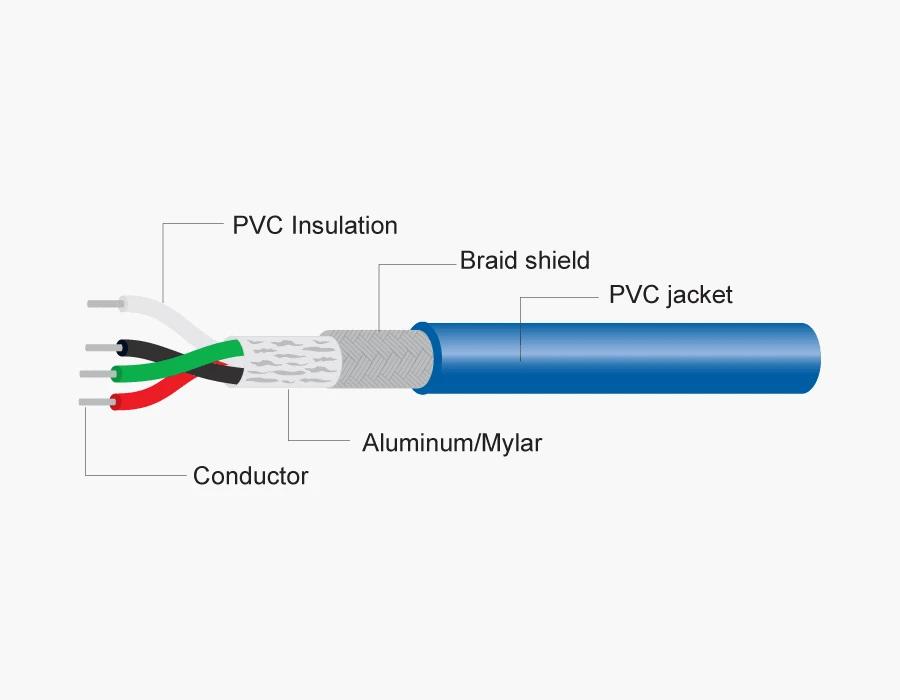
When people think about a USB charging cable, they usually focus on the connector, the copper wire, or the charging speed.
However, there is another manufacturing process that is just as important but often overlooked:
Core Insulation Extrusion
This process wraps every copper conductor with a layer of high-quality insulating material, such as:
HDPE (High-Density Polyethylene)
At first glance, this insulation may seem like it only prevents electrical short circuits.
In reality, it does much more than that.
The quality of the insulation directly affects:
Charging stability
Data transmission speed
Signal integrity
Cable durability
Characteristic impedance
Overall USB cable performance
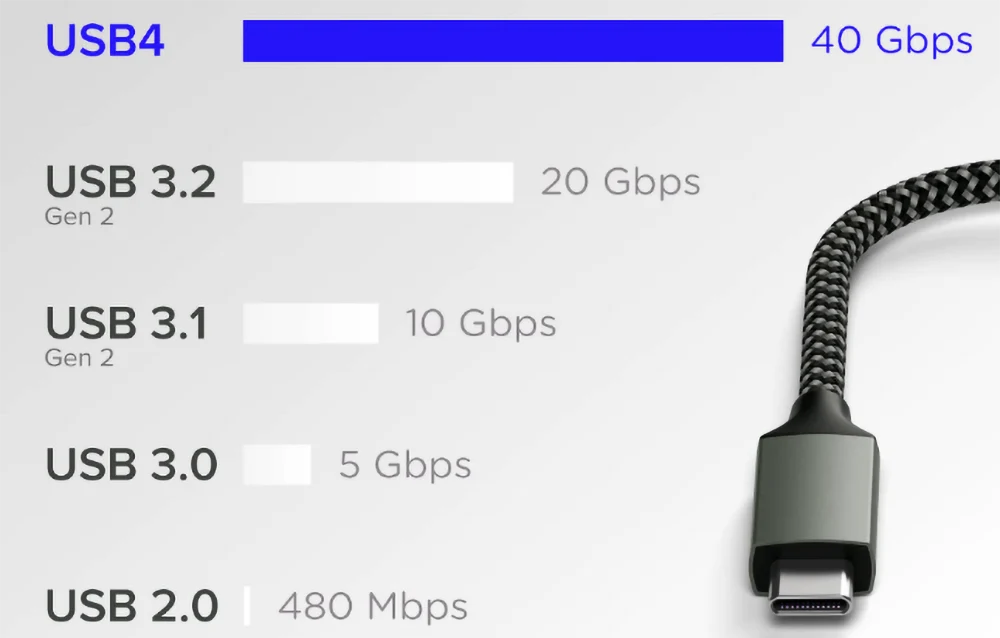
For modern USB-C, USB 3.2, USB4, and Thunderbolt cables, insulation quality is one of the key factors that determines whether a cable can achieve reliable high-speed data transmission.
In this article, we’ll explain how core insulation extrusion works, why HDPE insulation is widely used, and how it helps prevent signal loss and data packet errors.

What Is Core Insulation Extrusion?
Core Insulation Extrusion
is the manufacturing process of coating each copper conductor with an insulating plastic layer.
After the copper wire has been drawn and tin-plated, it enters an extrusion machine.
Inside the machine:
HDPE plastic pellets are heated until they melt.
The molten material flows around the moving copper wire.
The wire passes through a precision extrusion die.
The insulation is formed with a highly controlled thickness.
The insulated wire is rapidly cooled to maintain its shape.
The result is a perfectly insulated conductor ready for the next manufacturing step.

What Is HDPE?
HDPE (High-Density Polyethylene)
is one of the most commonly used insulation materials for premium USB cables.
It is chosen because it offers an excellent balance of:
Electrical insulation
Dimensional stability
Low dielectric loss
Mechanical strength
Heat resistance
Long-term reliability
For high-speed USB cables, HDPE performs much better than many lower-grade plastics.
Why Is Insulation More Than Just Electrical Protection?
Many people think insulation has only one purpose:
“To keep electricity from leaking.”
That is only part of its job.
For high-speed USB cables, insulation also controls one very important electrical property:
Characteristic Impedance
This is one of the most critical parameters in cable design.
What Is Characteristic Impedance?
Every high-speed cable has a designed electrical impedance.
For USB data lines, this impedance must stay within strict specifications.
You can think of impedance as:
The Smoothness of the Road for Electrical Signals
Imagine driving on a perfectly flat highway.
Your car moves smoothly and quickly.
Now imagine driving on a road with constant bumps and sudden width changes.
You have to slow down, and your journey becomes unstable.
Electrical signals behave in a very similar way.
When impedance is controlled correctly:
Signals travel smoothly.
Data arrives accurately.
Communication remains stable.

What Happens If Impedance Does Not Match?
Poor insulation quality or inconsistent insulation thickness can cause:
Impedance Mismatch
When impedance changes along the cable, part of the signal is reflected back toward the source instead of continuing forward.
This can lead to:
Signal reflections
Increased noise
Timing errors
Reduced signal quality
Data packet loss
Lower transmission speeds
This is especially important for:
USB 3.2
USB4
Thunderbolt
High-speed SSD connections
4K and 8K video transmission
Why Is HDPE Used in Premium USB Cables?
Manufacturers choose HDPE insulation because it provides excellent electrical performance.
Its advantages include:
1. Stable Dielectric Properties
HDPE has a low dielectric constant.
This helps maintain consistent signal transmission across different frequencies.
2. Excellent Impedance Control
Uniform HDPE insulation helps maintain consistent spacing between conductors.
This allows manufacturers to achieve precise impedance values required by USB standards.
3. Low Signal Loss
As data speeds increase, signal loss becomes a major challenge.
HDPE reduces dielectric loss, allowing more of the original signal to reach the receiving device.
This improves:
Data integrity
Communication stability
Overall cable performance
4. Better Heat Resistance
During manufacturing and everyday use, cables experience elevated temperatures.
HDPE maintains its shape and electrical properties even under these conditions.
This helps ensure consistent long-term performance.

Why Insulation Thickness Must Be Precisely Controlled
The insulation layer cannot be too thick or too thin.
If it is too thick:
Cable diameter increases
Flexibility decreases
Manufacturing costs rise
If it is too thin:
Electrical insulation may be reduced
Impedance may change
Signal quality may suffer
Modern extrusion equipment keeps insulation thickness extremely consistent, helping ensure reliable cable performance.
How Core Insulation Supports Fast Charging
Although insulation mainly affects data transmission, it also contributes to fast charging performance.
High-quality insulation:
Prevents electrical leakage
Improves safety
Maintains conductor separation
Supports stable high-current transmission
This is especially important for:
100W USB-C charging
140W USB-C charging
240W USB Power Delivery (PD 3.1)
Core Insulation and High-Speed Data Transmission
Modern USB standards continue to increase transmission speed.
Today’s premium USB cables may support:
USB 3.2
USB4
Thunderbolt 4
Thunderbolt 5
These technologies transmit enormous amounts of data every second.
Even tiny changes in insulation quality can affect signal performance.
That is why manufacturers invest heavily in precision insulation extrusion.
Why Cheap USB Cables Often Perform Poorly
Low-cost cables often reduce manufacturing expenses by using:
Lower-grade insulation materials
Inconsistent insulation thickness
Poor extrusion control
Inferior quality control
As a result, users may experience:
Slow data transfer
Connection instability
Signal interference
Random disconnections
Reduced cable lifespan
Although these cables may look identical from the outside, their internal construction is very different.
How to Identify a High-Quality USB Cable
When purchasing a USB cable, look for products that mention:
HDPE Insulation
High-speed data certification
USB4 compatibility
Precision manufacturing
Premium copper conductors
Quality shielding
Certified fast charging support
These features usually indicate better manufacturing quality.
The Future of USB Cable Insulation
As USB technology continues to evolve, signal frequencies and charging power will continue to increase.
Future cable insulation materials may offer:
Lower dielectric loss
Better thermal stability
Improved flexibility
More precise impedance control
Enhanced environmental durability
Advanced insulation technology will remain one of the foundations of next-generation USB cable performance.
Conclusion
Although it is hidden beneath the outer jacket, the insulation surrounding each conductor plays a critical role in modern USB cable performance.
Through:
Core Insulation Extrusion
and the use of:
HDPE Insulation
manufacturers create cables with:
Stable Characteristic Impedance
Excellent signal integrity
Reduced data packet loss
Reliable fast charging
High-speed data transmission
Long-term durability
The next time you use a USB-C cable, remember that its performance depends not only on the copper inside, but also on the precision-engineered insulation surrounding every conductor.

Fast delivery
Fastest delivery within 22 days

Quick proofing
Fastest 3-day proofing cycle

After-sale protection
24-month long warranty

1V1Customer Service
Professional customer service follow-up