
10 Questions to Ask a USB Cable Supplier Before Placing a Bulk Order
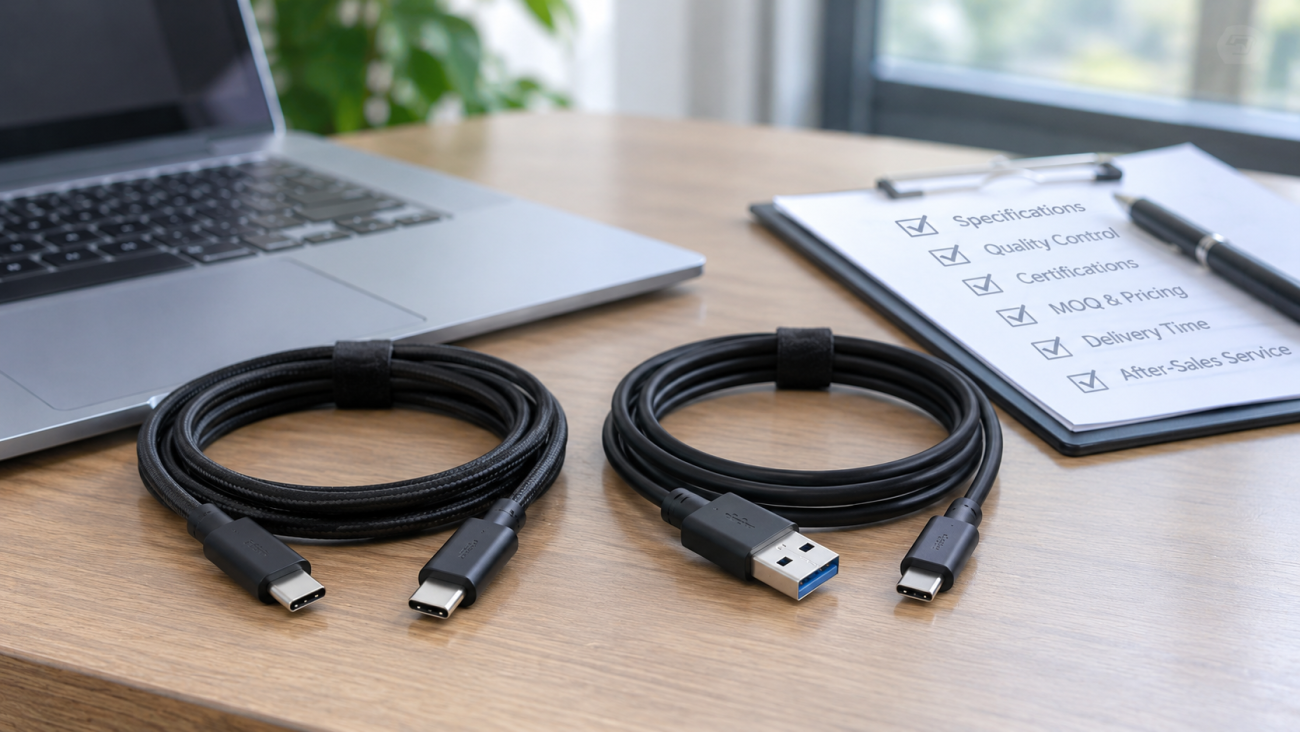
Before placing a bulk order, buyers should ask a USB cable supplier about product specifications, manufacturing capabilities, quality control, certifications, pricing, samples, and delivery terms. These questions help importers, wholesalers, and private-label brands reduce purchasing risks and find a reliable long-term supplier.
Choosing a USB cable supplier is not just about finding the lowest price. A cable may look identical to another product but have different conductor materials, electrical performance, connector quality, and service life.
If you are sourcing USB-C cables, USB-A to USB-C cables, or customized charging cables, ask the following 10 questions before confirming your order.
1. Are You a Manufacturer or a Trading Company?
This is one of the first questions to ask a potential supplier.
Question to ask:
“Are you a direct USB cable manufacturer or a trading company? Can you provide information about your factory and production facilities?”
Why Does This Matter?
A direct manufacturer may provide better control over production schedules, product customization, quality inspection, and manufacturing costs.
A trading company may also offer useful sourcing services and access to multiple factories. However, buyers should understand who actually manufactures the cables and who is responsible for quality issues.
What Should You Check?
Factory address and business registration information.
Production lines and manufacturing equipment.
Cable assembly and connector processing capabilities.
Quality inspection facilities.
Whether factory visits or live video inspections are available.
If possible, request real factory photos or a video showing the production process.
Do not rely only on factory pictures on a website. Verify whether the supplier can explain its actual manufacturing process.
2. What USB Cable Types and Specifications Can You Manufacture?
Before discussing prices, make sure the supplier can manufacture the exact products you need.
Question to ask:
“What types of USB cables do you manufacture? Can you provide detailed specifications for USB-C to USB-C, USB-A to USB-C, and other cable models?”
Why Does This Matter?
USB cables have different connector types, charging capabilities, data-transfer speeds, and construction requirements.
For example, a USB-C to USB-C cable designed for 60W charging is different from a cable designed for 240W USB PD 3.1 EPR applications.
A USB-C connector does not automatically mean that a cable supports high-speed data transfer or high-power charging.
What Specifications Should You Confirm?
| Specification | Details to Confirm |
|---|---|
| Connector type | USB-C to USB-C, USB-A to USB-C, USB-C to Lightning, etc. |
| Charging power | 60W, 100W, 240W, or other rated output |
| Current rating | 3A, 5A, or specified current |
| Data transfer | USB 2.0, USB 3.x, USB4, or charging-only |
| Cable length | 0.5m, 1m, 1.5m, 2m, or custom |
| Wire gauge | 24 AWG, 26 AWG, 28 AWG, or custom construction |
| Outer material | PVC, TPE, nylon braided, or other materials |
| Color | Black, white, or customized colors |
Ask the supplier to provide a technical specification sheet for each model. This makes it easier to compare quotations from different factories.
3. What Materials and Components Do You Use?
The materials inside a USB cable directly affect its electrical performance, flexibility, durability, and production cost.
Question to ask:
“What materials do you use for the conductors, insulation, outer jacket, shielding, and connectors? Can you provide the material specifications?”
Why Does This Matter?
Two cables may have the same appearance but use different internal materials.
For example:
Copper conductors generally provide better electrical conductivity than copper-clad aluminum (CCA).
Thicker power conductors can help reduce electrical resistance when properly designed.
TPE jackets offer flexibility for many applications.
Nylon braiding can provide additional abrasion protection.
Proper shielding can help control electromagnetic interference in applications that require it.
What Should You Check?
Ask whether the supplier can specify:
- Conductor material and wire gauge.
- Insulation material.
- Outer jacket material.
- Shielding structure, if applicable.
- Connector shell and contact materials.
- Strain-relief design.
Do not assume that a thicker-looking cable always has better electrical performance. Request material specifications and test results.
4. What Quality Control Procedures Do You Follow?
Quality control is one of the most important factors in bulk cable purchasing.
Question to ask:
“What quality control procedures do you follow during production? Do you conduct incoming material inspections, in-process inspections, and final product testing?”
Why Does This Matter?
Poor quality control can result in inconsistent products, charging failures, loose connectors, damaged cable jackets, and customer complaints.
A reliable supplier should have a defined inspection process rather than checking only a few finished products before shipment.
What Should a Quality Control Process Include?
| QC Stage | Inspection Items |
|---|---|
| IQC – Incoming Quality Control | Copper wire, connectors, jackets, electronic components, and raw materials |
| IPQC – In-Process Quality Control | Soldering, crimping, assembly, injection molding, and production consistency |
| FQC – Final Quality Control | Appearance, dimensions, connector performance, and electrical testing |
| OQC – Outgoing Quality Control | Packaging, labeling, quantity, and shipment inspection |
Depending on the product specification, testing may include:
Continuity and short-circuit testing.
Resistance and voltage-drop testing.
Charging performance testing.
Temperature-rise testing under specified conditions.
Insertion and withdrawal testing.
Bending and durability testing.
Data-transfer and signal-integrity testing, where applicable.
Ask the supplier to provide actual inspection records or sample test reports.
A supplier’s quality-control claims should be supported by documented procedures and measurable test results.
5. What Certifications and Test Reports Can You Provide?
Different markets have different regulatory and product-compliance requirements.
Question to ask:
“What certifications, declarations, and test reports are available for your USB cables? Can you provide documents that match the exact product model and our target market?”
Why Does This Matter?
Importers need to make sure that products meet the applicable requirements of their destination markets.
Common documents or standards that buyers may need to review include:
| Document or Standard | What It Relates To |
|---|---|
| RoHS | Restrictions on certain hazardous substances in electrical and electronic equipment |
| REACH | EU chemical-substance requirements |
| CE | Applicable EU product conformity requirements, where relevant |
| USB-IF certification | Compliance of specific USB products or models with applicable USB specifications |
| ISO 9001 | A company’s quality management system |
| UL-related documentation | Applicable safety requirements for relevant materials or components |
Not every USB cable requires the same set of documents. Requirements depend on product design, intended use, destination market, and applicable regulations.
What Should You Verify?
Does the document cover the actual product being purchased?
Is the model number consistent with the quotation and product specification?
Is the issuing laboratory or certification organization identifiable?
Is the document valid and applicable to the intended market?
Are the materials and product configuration consistent with the tested sample?
Remember that ISO 9001 is a quality management system certification, not a product certification. Likewise, a supplier should not claim that every cable is USB-IF certified simply because it has one certified product model.
6. Can You Provide Samples Before Mass Production?
Never approve a large order based only on product photos or a quotation.
Question to ask:
“Can you provide samples for testing before mass production? What is the sample cost, lead time, and shipping arrangement?”
Why Does This Matter?
Samples allow buyers to check whether the product meets their requirements before committing to a large quantity.
You can evaluate:
Cable appearance and finish.
Connector fit and insertion performance.
Cable flexibility.
Actual cable length and dimensions.
Charging performance.
Data-transfer capability, if specified.
Packaging quality.
Recommended Sample Approval Process
- Send the supplier your required specifications.
- Request samples that match the proposed mass-production design.
- Test the samples with compatible chargers and devices.
- Check electrical performance and mechanical durability.
- Confirm the approved sample in writing.
- Keep a reference sample for comparison during mass production.
For customized orders, make sure the approved sample matches the final materials, connectors, cable length, color, and packaging requirements.
7. What Is Your MOQ and Can You Support OEM/ODM Customization?
If you are building your own brand or selling through wholesale channels, customization may be an important purchasing requirement.
Question to ask:
“What is your minimum order quantity (MOQ)? Can you provide OEM or ODM services, including custom logos, cable colors, packaging, and product specifications?”
Why Does This Matter?
Different suppliers have different production arrangements and minimum order requirements.
Some factories may accept smaller orders for standard products but require higher quantities for customized colors, molds, packaging, or special cable constructions.
Common Customization Options
| Customization Item | Possible Requirements |
|---|---|
| Logo | Laser engraving, printing, or molded logo |
| Cable color | Black, white, or custom Pantone color |
| Cable length | 0.5m, 1m, 1.5m, 2m, or custom |
| Outer material | PVC, TPE, nylon braided |
| Connector housing | Custom design, color, or material |
| Packaging | Retail box, polybag, paper box, or private-label packaging |
| Electrical specifications | Customized power and data requirements |
Before ordering, confirm:
MOQ for standard and customized products.
Whether there are additional mold or setup charges.
Logo artwork requirements.
Packaging design and printing costs.
Whether the supplier can keep your approved specifications consistent across repeat orders.
8. What Are Your Production Capacity and Lead Time?
A supplier may offer an attractive price but still fail to deliver on time.
Question to ask:
“What is your monthly production capacity? How long does it take to produce a standard order and a customized order?”
Why Does This Matter?
Production capacity and delivery schedules directly affect inventory planning, sales campaigns, and customer commitments.
If you are purchasing thousands or tens of thousands of cables, the supplier needs to demonstrate that it can handle the order without compromising product quality.
What Should You Confirm?
Monthly production capacity.
Current production workload.
Sample lead time.
Mass-production lead time.
Packaging preparation time.
Peak-season production arrangements.
Whether partial shipments are possible.
Ask for a realistic production schedule based on your actual quantity and product specifications.
For customized orders, remember that sample approval, packaging design, and raw material preparation may add time before mass production begins.
9. What Are Your Prices and Payment Terms?
Price is important, but buyers should compare quotations based on the same product specifications.
Question to ask:
“Could you provide a detailed quotation, including unit price, MOQ, sample cost, tooling charges, packaging cost, payment terms, and shipping terms?”
Why Does This Matter?
A low unit price does not always mean a lower total purchasing cost.
One supplier may quote a basic PVC cable, while another quotes a nylon-braided cable with thicker conductors and different connectors. Comparing these prices directly would be misleading.
What Should a Complete Quotation Include?
| Quotation Item | Information to Confirm |
|---|---|
| Unit price | Price per piece |
| MOQ | Minimum order quantity |
| Sample cost | Free or paid samples |
| Customization cost | Logo, mold, color, and packaging charges |
| Payment terms | Deposit and balance payment conditions |
| Incoterms | EXW, FOB, CIF, DAP, or DDP, as applicable |
| Production lead time | Estimated time after order confirmation |
| Quotation validity | How long the price remains valid |
For an accurate comparison, send the same technical specification sheet to every supplier.
Also confirm whether the quotation includes packaging, inspection, and other additional costs.
10. What Is Your After-Sales Policy for Quality Problems?
The supplier’s responsibility should not end when the goods leave the factory.
Question to ask:
“What is your warranty policy? If we find quality problems after receiving the goods, how do you handle claims, replacements, or compensation?”
Why Does This Matter?
Even suppliers with established quality-control systems may encounter product issues. What matters is whether they have a clear process for investigating and resolving them.
What Should You Confirm?
Warranty period and coverage.
Definition of acceptable and unacceptable defects.
Required evidence for quality claims.
Claim submission deadline.
Inspection and investigation process.
Replacement or compensation arrangements.
Responsibility for return shipping, where applicable.
For long-term cooperation, clarify these terms in the purchase agreement rather than relying only on verbal promises.
A professional supplier should be willing to discuss quality responsibilities before receiving an order.
A USB Cable Supplier Evaluation Checklist
After asking these 10 questions, use a simple evaluation table to compare potential suppliers.
| Evaluation Criteria | Suggested Weight |
|---|---|
| Product quality and testing | 25% |
| Manufacturing capability | 15% |
| Technical knowledge | 15% |
| Certifications and documentation | 10% |
| OEM/ODM customization | 10% |
| Price and MOQ | 10% |
| Production capacity and delivery | 10% |
| Communication and after-sales service | 5% |
| Total | 100% |
These weights are a suggested purchasing framework, not an industry standard. You can adjust them based on your business priorities.
For example, a private-label brand may place more importance on customization, while a high-volume distributor may prioritize production capacity and consistent quality.
Warning Signs to Watch for When Choosing a USB Cable Supplier
Be careful if a supplier:
Cannot explain the technical specifications of its products.
Refuses to provide samples or relevant test records.
Claims that every USB-C cable supports 100W or 240W.
Cannot explain its manufacturing or quality-control process.
Provides certificates that do not match the quoted product.
Gives an unusually low price without explaining the materials or specifications.
Avoids discussing warranty and quality responsibilities.
Frequently changes delivery commitments without a clear explanation.
One warning sign does not automatically mean a supplier is unreliable, but several unresolved issues should make you investigate further before placing an order.
Frequently Asked Questions
Q1: How do I know if a USB cable supplier is reliable?
Check its manufacturing capabilities, product specifications, quality-control procedures, relevant test reports, sample quality, delivery performance, and after-sales policy. Factory verification and clear communication are also important.
Q2: Should I request samples before placing a bulk USB cable order?
Yes. Samples allow you to verify product appearance, connector quality, cable construction, charging performance, and data-transfer capability before mass production. For customized products, approve a sample that matches the final production specifications.
Q3: What documents should a USB cable supplier provide?
Depending on the product and destination market, buyers may need product specifications, applicable RoHS or REACH documentation, relevant test reports, and USB-IF certification information if the supplier claims certification. Always verify that documents match the actual product model.
Q4: What is a reasonable MOQ for USB cables?
There is no universal MOQ. It depends on cable type, materials, customization, packaging, production process, and supplier capacity. Standard products may have lower MOQs than customized products. Ask for separate MOQs for standard and OEM orders.
Conclusion
Choosing the right USB cable supplier requires more than comparing prices. Before placing a bulk order, ask about manufacturing capabilities, technical specifications, materials, quality control, certifications, samples, customization, production schedules, payment terms, and after-sales support.
These 10 questions give importers, wholesalers, distributors, and private-label brands a practical way to evaluate suppliers and reduce purchasing risks.
Looking for a USB cable manufacturer for your next wholesale or OEM/ODM project? APPHONECABLE supplies USB-C cables, USB-A to USB-C cables, and customized charging cable solutions for B2B customers. Contact our team to discuss your product specifications, samples, and bulk order requirements.
USB cable.
Picture this: You’re sitting at your desk, engrossed in a project
Where Can I Buy a High-Quality Pd Fast Charging Cable?
FAQ
1 cable
USB-C cables certainly.
Share This Artcle:

Fast delivery
Fastest delivery within 22 days

Quick proofing
Fastest 3-day proofing cycle

After-sale protection
24-month long warranty

1V1Customer Service
Professional customer service follow-up
Lorem ipsum dolor sit amet, consectetur adipiscing elit. Ut elit tellus, luctus nec ullamcorper mattis, pulvinar dapibus leo.